Why Do My Knees Hurt When I Exercise?
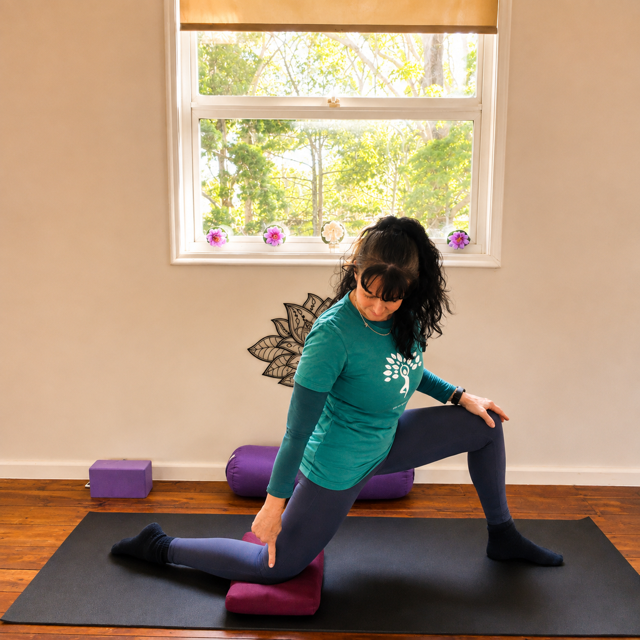
Jodie teaching low lunge with cushion under knee for support. This stretch helps to open the hips and lower back!
Low-Impact Exercise for Beginners | Knee-Friendly
If your knees hurt when you exercise, it can be tempting to think that exercise isn’t for you!
But knee discomfort doesn’t necessarily mean you have to stop moving altogether.
As a Pilates and wellness coach, I work with many beginners and people over 50 who come to class with different limitations — from sensitive knees and wrists to back issues, reduced mobility, or simply a lack of confidence after not exercising for a while.
One of the most important things I encourage is working with your body rather than forcing it.
Why Might Your Knees Hurt During Exercise?
There are many possible reasons for knee pain or discomfort.
It may be related to previous injury, arthritis, reduced mobility, weakness in the muscles supporting the knee, exercise technique, doing too much too soon, or simply choosing movements that aren’t appropriate for your body.
That’s why there isn’t one exercise program that suits everybody.
If knee pain is new, severe, persistent, associated with swelling or instability, or you’re unsure about its cause, it’s important to have it assessed by an appropriate health professional.
You Don’t Have to Spend a Whole Class Kneeling
One concern I hear from people with sensitive knees is:
“But won’t Pilates involve lots of kneeling?”
It doesn’t have to.
In my own classes, I deliberately try not to include too many kneeling exercises.
When we do kneel, I encourage students who need extra comfort to place a folded towel or cushion underneath their knees.
And if kneeling simply isn’t comfortable for someone, we find another exercise.
There are so many ways to work the same muscles without forcing yourself into a position that hurts.
Choose Exercises That Can Be Modified
A good beginner exercise program should offer variety.
In my Kevala Health classes, I use a wide range of exercises because everyone arrives with a different body and different needs.
One person may have sensitive knees.
Someone else may have wrist problems.
Another person may need to be careful with their back.
That’s why I believe modifications are such an important part of exercise — particularly for beginners and as we get older.
An exercise doesn’t have to look exactly the same for everyone to be beneficial.
Strengthening Your Legs Supports Your Knees
When our knees are sensitive, we can become afraid of strengthening the legs.
But maintaining strength in the muscles around the hips, thighs, and lower legs is an important part of supporting everyday movement and knee function.
Depending on your individual circumstances, suitable exercises might include:
Sit-to-stand movements from a chair
Supported squats within a comfortable range
Glute bridges
Standing leg exercises
Calf raises
Gentle resistance-band exercises
Low-impact Pilates exercises
The goal isn’t to push through knee pain.
It’s to gradually build strength using movements that your body tolerates well.
Don’t Forget Your Core
Your knees don’t work in isolation.
Core and hip strength help support the way your whole body moves, including your posture, balance, and control during everyday activities.
That’s one reason Pilates can be such a useful form of exercise for beginners. We aren’t only concentrating on one joint — we’re working on how the body functions together.
Improving overall strength and control may make everyday movements such as getting out of a chair, climbing stairs, and walking feel easier and more confident.
Low Impact Doesn’t Mean No Impact on Your Fitness
You don’t have to jump, run, or perform deep lunges to get a worthwhile workout.
Low-impact options can include:
Pilates – for strength, core control, balance, and mobility.
Gentle yoga – for mobility, flexibility, balance, and body awareness.
Walking – an accessible way to build regular movement into your day.
Low-impact cardio – movement that raises your heart rate without jumping or pounding.
Resistance training – using light weights, resistance bands, or your own body weight to gradually build strength.
The best exercise isn’t necessarily the hardest one.
It’s the exercise you can perform safely, consistently, and comfortably enough to keep coming back to.
What If an Exercise Hurts My Knees?
Pain isn’t something you need to prove you can push through.
If a particular exercise hurts, stop and change the movement.
You may be able to:
Reduce your range of movement
Slow the exercise down
Use support for balance
Add cushioning under your knees
Change your position
Choose a different exercise targeting similar muscles
And sometimes the right decision is simply not to do that particular exercise today.
That’s perfectly okay.
Start Where Your Body Is Today
If you’ve avoided exercise because of your knees, you don’t need to suddenly launch into a difficult workout.
Start gently.
Build your strength gradually.
Use modifications when you need them.
And remember that your exercise doesn’t have to look like anybody else’s.
After more than 20 years of teaching, one thing I continue to believe strongly is that movement should be adapted to the person, not the person forced to fit the exercise.
Your knees may need a little extra consideration, but that doesn’t mean the rest of your body has to miss out on the benefits of movement.
Try a Knee-Friendly Beginner Workout
If you’d like a gentle place to start, try my Beginner Abs Workout – Knee-Friendly video.
You can also explore Pilates for Beginners for more information about starting Pilates safely and confidently.
Ready to try a class? If you’d like to put these ideas into practice, you can try 7 days of live online Yoga & Pilates free with Kevala Health.
Join from home and explore beginner-friendly classes at your own pace.
Important: This article provides general exercise and wellbeing information and is not a substitute for individual medical or physiotherapy advice. If you have significant, unexplained, or persistent knee pain, an injury, swelling, instability, or concerns about exercising, seek advice from an appropriate qualified health professional before beginning or changing your exercise program.