How To Improve Balance After 50?
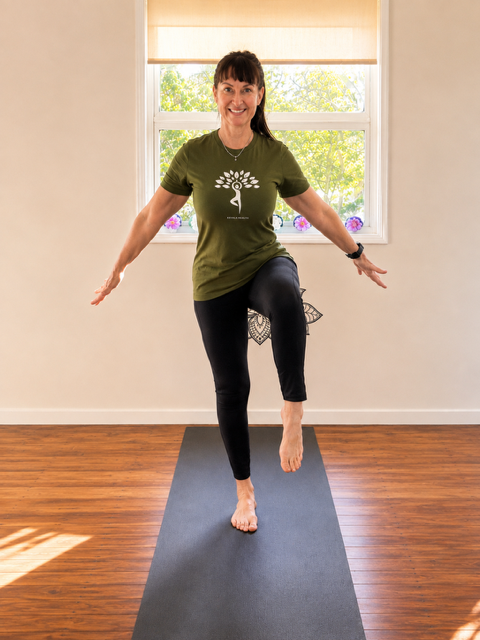
Jodie teaching a simple one-leg balance to help strengthen the body and improve mobility after 50!
Why Does Balance Get Worse with Age?
Have you noticed that your balance isn’t quite what it used to be?
Perhaps you feel less steady standing on one leg, you’re more cautious walking on uneven ground, or you automatically reach for something when putting on your shoes.
Changes in balance can become more noticeable as we get older — but that doesn’t mean we simply have to accept becoming unsteady.
Balance is something we can continue to practise and improve.
Understanding why it changes is a great place to start.
Why does balance get worse as we age?
Good balance is actually quite complex.
Your brain is constantly receiving information from your eyes, inner ear, muscles, joints and feet to work out where your body is in space and make tiny adjustments to keep you upright.
As we age, several of these systems can gradually change.
Vision may become less sharp. Our reaction times can slow. Muscle strength can decrease, and we may lose some mobility and body awareness.
If we also become less physically active, we simply don’t challenge our balance as often.
The good news is that many of the physical abilities involved in balance can be trained.
Strength and balance work together
Balance isn’t just about being able to stand on one leg.
Strong legs, hips, ankles and core muscles help us control our body and respond when our position changes.
Think about stepping off a curb, walking across uneven grass or catching yourself after an unexpected stumble.
Your muscles need to react quickly enough to help stabilise you.
That’s one reason I place so much emphasis on maintaining strength as we age.
Pilates and resistance exercises can help strengthen the muscles we rely on for everyday movement while also improving body awareness and control.
Don’t forget your feet and ankles
Our feet are our connection with the ground, yet they’re often forgotten when we think about healthy ageing.
Strong, mobile feet and ankles help us respond to changes underneath us.
Simple movements such as pointing and flexing the feet, ankle circles, spreading the toes and controlled heel raises can all help us maintain awareness and movement through this area.
Walking on different safe surfaces can also give the body valuable sensory information.
Balance needs to be practised
One of the simplest principles is this:
If you want to maintain your balance, practise balancing.
That doesn’t mean doing complicated exercises.
You might begin by standing with your feet closer together while holding a stable support, practising controlled weight shifts or briefly lifting one foot.
As your confidence improves, exercises can gradually become more challenging.
The important thing is to work at a level that feels safe for you.
Pilates Can Help Develop Control
Pilates can be particularly useful for balance because it develops more than just strength.
We work on core control, posture, coordination, mobility and awareness of how the body is moving.
Standing Pilates exercises can challenge balance directly, while floor exercises help strengthen many of the muscles needed to support us when we’re upright.
Using balls, bands or light weights can add another layer of coordination and resistance.
Yoga Helps Improve Balance
Yoga provides another way to practise balance while developing mobility and body awareness.
Standing poses encourage us to slow down and notice how we’re distributing our weight.
But yoga doesn’t have to involve difficult one-legged poses.
Gentle movements, supported balance exercises and transitions between positions can all challenge the body in useful ways.
Breathing slowly can also help us remain calm rather than tensing up when something feels challenging.
Balance is Important for Confidence
There’s another side to balance that isn’t purely physical.
Confidence matters.
When people begin to worry about falling, they can understandably start avoiding activities that make them feel unsteady.
But becoming less active can gradually reduce strength and balance even further.
Building confidence through safe, progressive movement can help break that cycle.
You don’t need to be perfect at balancing.
A little wobble often means your body is working and making adjustments.
Everyday life is balance training too
Balance doesn’t only happen during an exercise class.
We use it constantly.
Walking, gardening, stepping over something, getting up from the floor, climbing stairs and moving around different surfaces all require balance.
Staying active therefore gives your body regular opportunities to practise the skills it needs for everyday life.
Can you Improve Balance After 50 or 60?
Absolutely.
Ageing doesn’t mean that improvement stops.
Regular exercise that includes balance practice, strength, mobility and general physical activity can help maintain physical function as we grow older.
The key is consistency.
Five minutes of safe balance practice performed regularly can be more useful than doing a long session once and then forgetting about it for several weeks.
Start safely
If you’re new to balance exercises, practise near a wall, sturdy chair or bench so you have something to hold if necessary.
Don’t rush to close your eyes or attempt advanced exercises simply because you’ve seen someone else doing them.
Everyone starts at a different level.
And if you’ve recently developed significant balance problems, dizziness, unexplained falls or other concerning symptoms, it’s important to speak with your GP or appropriate health professional before assuming it’s simply part of ageing.
Keep moving, keep practising
One of my favourite things about teaching movement is seeing someone’s confidence grow.
An exercise that initially feels wobbly can gradually become steadier.
A movement that seemed intimidating starts to feel achievable.
That’s what healthy ageing means to me.
It’s not about trying to move exactly as we did when we were 25.
It’s about continuing to give our bodies the strength, mobility, balance and confidence we need to enjoy everyday life.
And balance is definitely worth practicing.
Continue Your Healthy Ageing Journey