Getting Stronger After 60
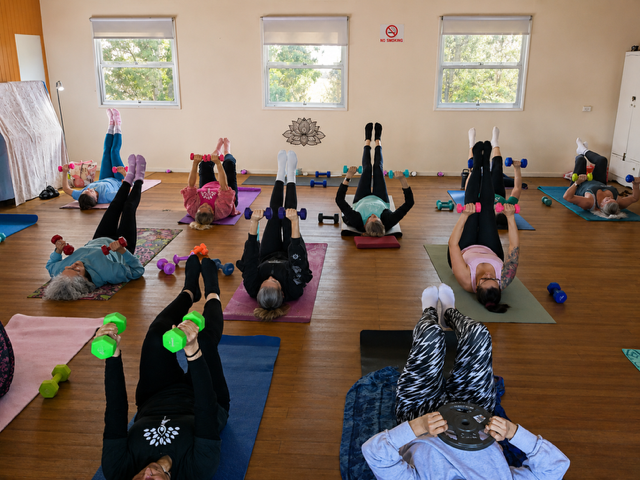
Kevala Health Pilates class with hand weights. Available for live online students or Russell island.
Research Says You Can Get Stronger After 60
If you’re in your 60s and wondering whether it’s too late to start building strength, I have some very good news.
You can still get stronger after 60.
Our bodies change as we age, and maintaining muscle becomes increasingly important. But getting older doesn’t mean we have to simply accept becoming weaker every year.
Research consistently shows that older adults can improve muscular strength through appropriate resistance exercise.
And you don’t necessarily need to become a gym person or lift extremely heavy weights to benefit.
The most important thing is to start at an appropriate level, gradually challenge your muscles, and keep moving consistently.
Why do we lose strength as we get older?
From midlife onwards, we can gradually lose muscle mass and strength, particularly if we’re not physically active.
This age-related loss of muscle is often referred to as sarcopenia.
It can affect much more than how strong we feel during exercise.
Muscle helps us:
Get up from a chair
Climb stairs
Carry groceries
Maintain good posture
Support our joints
Balance and react to a stumble
Get down onto the floor and back up
Continue doing the activities we enjoy
That’s why maintaining strength isn’t simply about fitness.
It’s an important part of maintaining independence as we age.
Building Stronger Muscles After 60
Older muscles can still respond to resistance training.
When we regularly challenge our muscles with an appropriate amount of resistance, the body adapts.
Over time, we can improve strength and physical function — even if we haven’t exercised seriously before.
That doesn’t mean everyone will develop large muscles or needs to lift very heavy weights.
For most people interested in healthy ageing, the goal is much more practical:
Build enough strength to support the life you want to live.
What Kind of Exercise Builds Strength?
Resistance exercise simply means your muscles are working against some form of resistance.
That resistance might come from:
Your own body weight
Hand weights
Resistance bands
Pilates balls and bands
Gym equipment
Functional movements such as squats and controlled sit-to-stands
You don’t need every type.
The best starting point depends on your current strength, mobility, confidence, and any injuries or health considerations.
Is Pilates Enough to Help You Get Stronger?
Pilates can play a very useful role in building and maintaining strength, particularly for beginners and people returning to exercise.
Pilates works the core, legs, hips, upper body, and postural muscles while also developing balance, coordination, and body awareness.
I also like incorporating resistance into Pilates using hand weights, resistance bands, and balls.
As you become stronger, however, the exercises need to continue providing enough challenge.
That’s an important principle at any age.
If we always do exactly the same movement with exactly the same resistance, our body becomes accustomed to it.
Gradual progression helps us continue improving.
Strength training isn’t just for your muscles
One reason I’m so passionate about strength after 50 and 60 is that its benefits go beyond muscle.
Appropriate resistance exercise can support:
Bone health
Our bones respond to appropriate loading and resistance, which becomes particularly important as we age.
Balance
Stronger legs, hips, and core muscles can help us control our bodies and respond when we lose our balance.
Everyday movement
Getting out of a chair, carrying shopping, and climbing stairs all require strength.
Confidence
Feeling physically capable can make us more confident about staying active and trying new things.
What about women after menopause?
Strength becomes particularly important for women during and after menopause.
Hormonal changes during this stage of life are associated with changes in bone and body composition, while age-related muscle loss continues.
That’s why I encourage women not to think of resistance exercise simply as a way of changing how their bodies will look.
Think about what you’re building for your future.
Strong legs.
Strong hips.
A strong back.
Better balance.
The ability to continue doing everyday things independently.
Those are powerful reasons to keep working on strength.
Do you need heavy weights after 60?
Not necessarily — particularly when you’re starting.
The resistance needs to be challenging enough for your muscles, but appropriate for your individual ability.
Someone who hasn’t exercised for years might initially find body-weight movements or light resistance bands challenging.
Someone who has trained consistently for years may require considerably more resistance.
That’s why there’s no single weight that’s right for every 60-year-old.
Progression matters more than comparison.
Start where you are and gradually progress as your strength and confidence improve.
Don’t forget balance, mobility, and cardio
Strength is important, but healthy ageing isn’t about strength alone.
I believe in combining different types of movement.
Resistance training helps maintain strength.
Walking, swimming, cycling, dancing, and low-impact cardio support cardiovascular fitness.
Pilates develops strength, control, and stability.
Yoga can support mobility, flexibility, balance, and relaxation.
And everyday activities such as gardening and walking all contribute to keeping us moving.
Rather than searching for one perfect exercise, think about creating a well-rounded movement routine.
How often should you work on strength?
For many adults, including older adults, health guidelines recommend muscle-strengthening activities on at least two days each week.
That doesn’t mean you need to do an exhausting full-body workout every day.
Your muscles also need recovery.
A sustainable routine that you can maintain week after week is far more valuable than doing too much, becoming sore or injured, and then stopping altogether.
What if you’ve never exercised before?
Your 60s are not too late to begin.
In fact, starting now can be one of the best investments you make in your future mobility and independence.
Begin with simple movements.
Learn good technique.
Use support when you need it.
Gradually add resistance.
And don’t worry about what everyone else can do.
If you have osteoporosis, significant joint problems, heart conditions, recent surgery, or other medical concerns, speak with your GP or appropriate health professional about the safest way for you to begin.
Think about your future self
When I teach strength and Pilates, I’m not interested in trying to make everyone exercise like they’re 25.
I’m interested in helping people build bodies that support their lives.
I want to be able to garden.
Travel.
Walk comfortably.
Get down onto the floor and back up.
Carry things.
Balance.
Teach.
And continue doing the things I enjoy as I grow older.
That’s why strength matters.
You don’t have to be young to become stronger.
You simply need to give your body a reason to adapt — and keep giving it that reason consistently.
So if you’re 60, 65, 70, or beyond and wondering whether it’s worth starting? It absolutely is.
Continue Your Healthy Ageing Journey: